


Healthy aging is increasingly used as a target in nutrition, supplements and pharma pipelines. But while interest is growing, R&D teams still face the same challenge: how to translate microbiome effects into outcomes that are biologically meaningful and commercially defensible.
In this post, we look at healthy aging as an example of how our integrated, three‑layered approach connects gut microbiome modulation to systemic relevance, without jumping prematurely to clinical trials.
Why healthy aging matters now
Healthy aging is not a trend label. It reflects a structural shift in how health interventions are being developed and evaluated:
- R&D pipelines must de‑risk earlier, before initiating costly clinical trials
- Claims increasingly need mechanistic support, not associative correlations
- Regulatory and payer pressure is moving focus from disease treatment to functional preservation
The gut microbiome sits at the center of this shift. It offers promise but fall short without mechanistic translation claims. At ProDigest, we close this gap using our three-layered study approach.
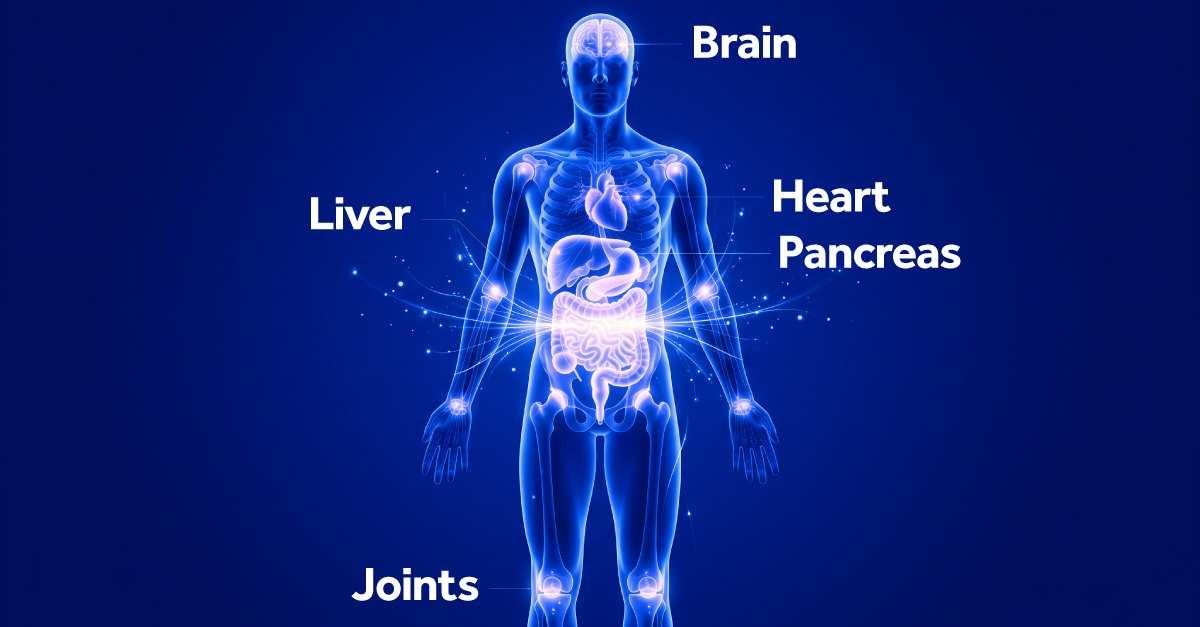
The three biological levels
Layer 1: Gut microbiome activity
What happens inside the gut?
Using SHIME® and Colon‑on‑a‑Plate®, we simulate key aspects of human gut physiology to assess microbial fermentation, composition and interindividual variability. Rather than focusing only on which microbes are present, this layer captures functional activity, what the microbiome is actually doing under real life conditions.
This allows R&D teams to address questions that simple screening models cannot:
- Consistency of effect: does an ingredient show reproducible, functionally relevant effects across microbiomes from different individuals, or are responses highly donor‑dependent?
- Functional relevance: which microbial functions are modulated (such as short‑chain fatty acid production or proteolytic activity) beyond shifts in taxonomy alone?
By testing ingredients across microbiota from multiple donors, this layer directly supports early R&D decisions:
- Ingredient selection: prioritizing candidates with robust, consistent functional effects
- Responder stratification: identifying response patterns linked to baseline microbiome differences
- Go/no‑go decisions: stopping or redirecting programs before advancing to costly in vivo or clinical studies
Healthy aging research benefits particularly from this approach, as microbiome variability among elderly individuals is both high and biologically meaningful, making early assessment of robustness and variability essential.
Layer 2: Translation at the gut wall
Do microbial changes matter to the host?
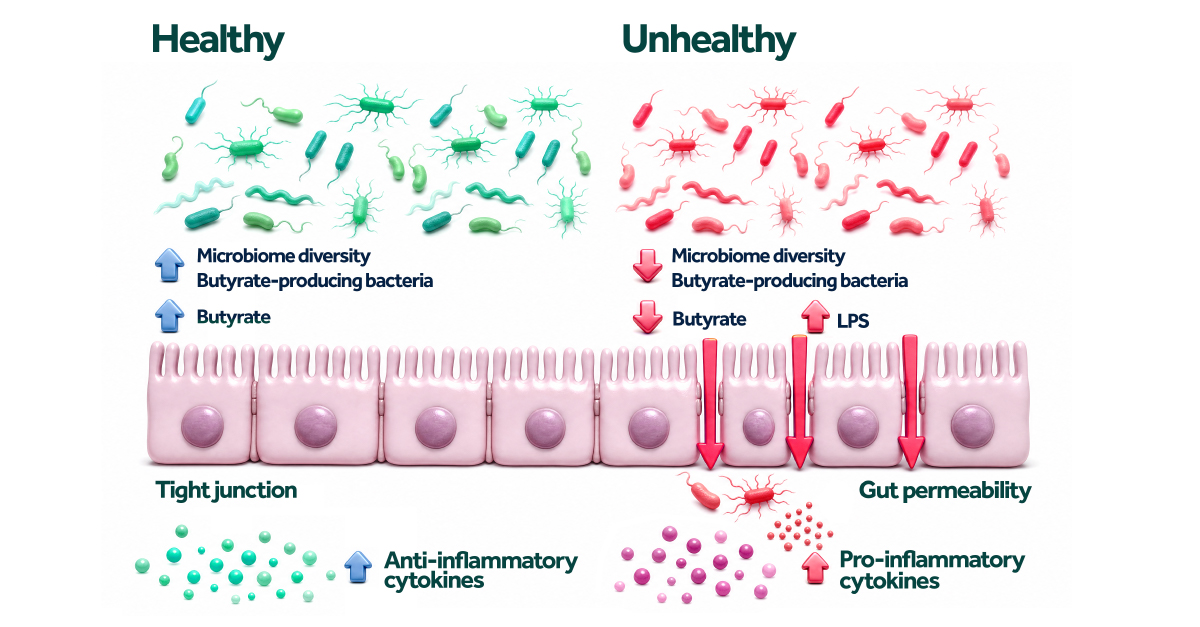
Microbiome modulation only becomes biologically and commercially relevant when it translates into host‑level effects. By linking outputs from gut microbiome models directly to gut‑wall systems (Caco‑2/THP1 and Caco-2/PBMC‑based leaky gut models) we assess whether microbiome‑driven changes result in functional responses at the host interface, including:
- Barrier resilience: the ability of the intestinal epithelium to maintain or restore integrity under inflammatory or stress conditions (“tight” vs. “leaky” gut)
- Inflammatory resilience: modulation of pro‑inflammatory signaling pathways and cytokine responses
- Immune responsiveness: effects on innate immune activation and immune balance
The figure below shows how this layer provides valuable insights, correlating healthy aging with preserved and increased microbial diversity, maintenance of short‑chain fatty acids (SCFAs, e.g. butyrate), bile acid and antioxidant producers, as well as strong mucosal and systemic anti-inflammatory control.
This is where many microbiome programs stall and where differentiation begins. While microbiome‑only approaches often stop at compositional or metabolic readouts, explicitly testing microbiome-host interactions at the gut wall moves beyond correlation towards mechanism. This step is essential for building credible links between gut‑level modulation and downstream health effects, and for supporting more confident decision‑making in product development.
Layer 3: Systemic relevance
How do local gut effects scale to whole‑body health?
Microbiome‑derived metabolites act as key messengers between the gut and distant organs, linking local microbial activity to systemic processes. By prioritizing metabolites consistently associated with healthy aging (such as SFCAs, bile acids and indole derivatives) we pinpoint on signals that are biologically relevant beyond the gut.
Our MetaKey® platform provides focused, gut‑relevant metabolite profiles, filtering out noise to concentrate on pathways most likely to contribute to systemic effects. SIMON® adds the interpretation layer, integrating metabolite patterns with upstream microbiome data to translate them into clear, biologically meaningful insights.
This enables the R&D teams that we serve to move from observation to action. For example, when two ingredients show similar effects on microbial composition and fermentation, but only one consistently increases a metabolite profile linked to immune regulation, this layer helps teams prioritize the stronger candidate for further development or clinical evaluation, while deprioritizing the former.
By grounding systemic interpretation in microbiome‑derived metabolites, this layer allows gut‑level effects to be connected to processes central to healthy aging (such as metabolic balance and immune regulation) without overclaiming or relying on indirect associations.
Other examples benefitting from our three-layer approach
Healthy aging is used here as a case study, not a boundary. The same three‑layer approach applies to a wide range of health indications, wherever microbiome modulation needs to be translated into biologically meaningful and commercially actionable outcomes. A few examples:
- Gut barrier support and digestive comfort
- Metabolic health and weight management
- Gut-brain axis and cognitive resilience
- Immune resilience and infection preparedness
- Next-generation biotics and strain optimization
Conclusion: from gut insight to system‑level relevance
By integrating gut microbiome models, host‑response assays and metabolite‑driven data interpretation, our three‑layered approach exposes mechanistic links between microbial activity and systemic processes relevant to human and animal health.
Curious how we can support your indication? Let’s talk!